
Floor Plans
Total Environment Sarjapur Floor Plans and Configurations
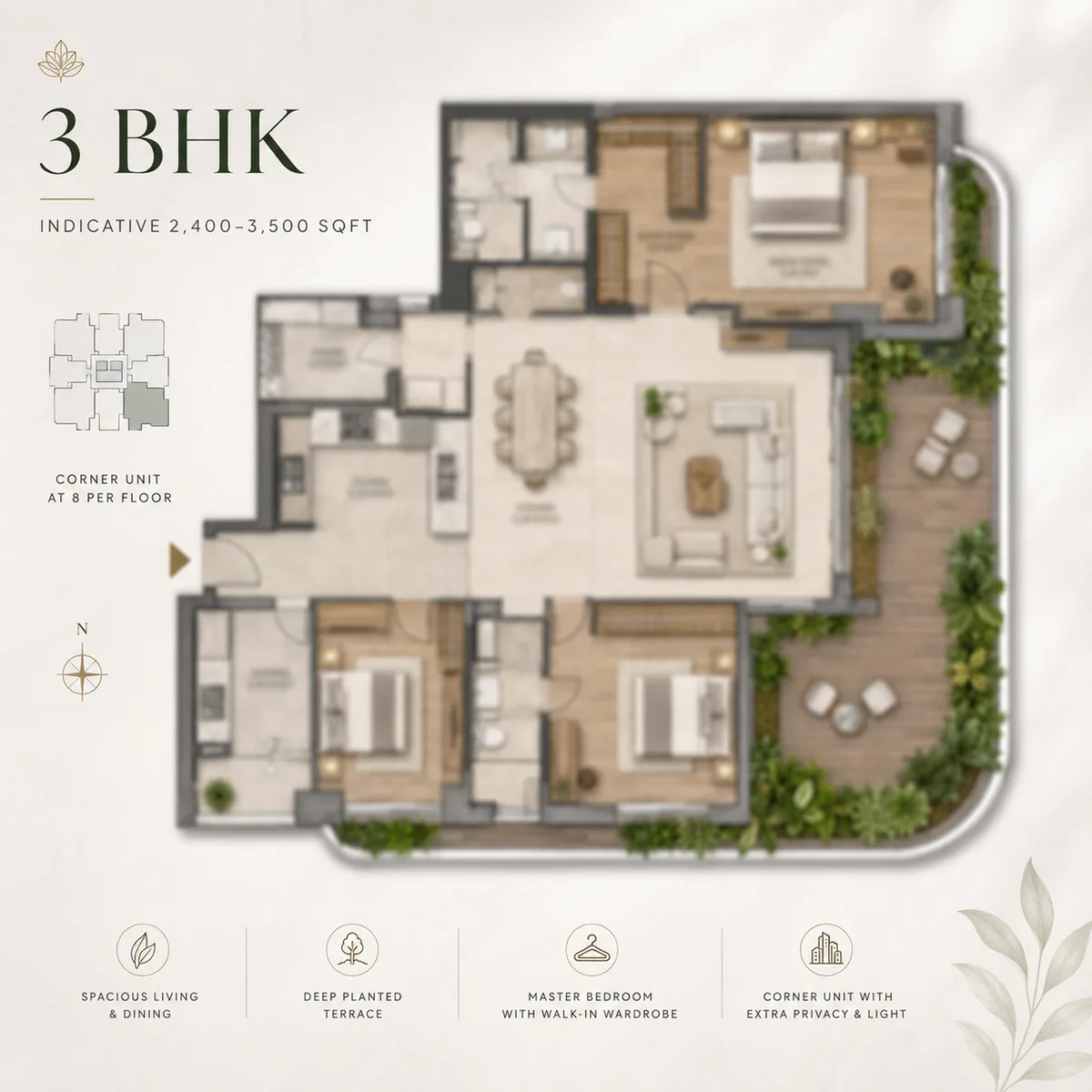
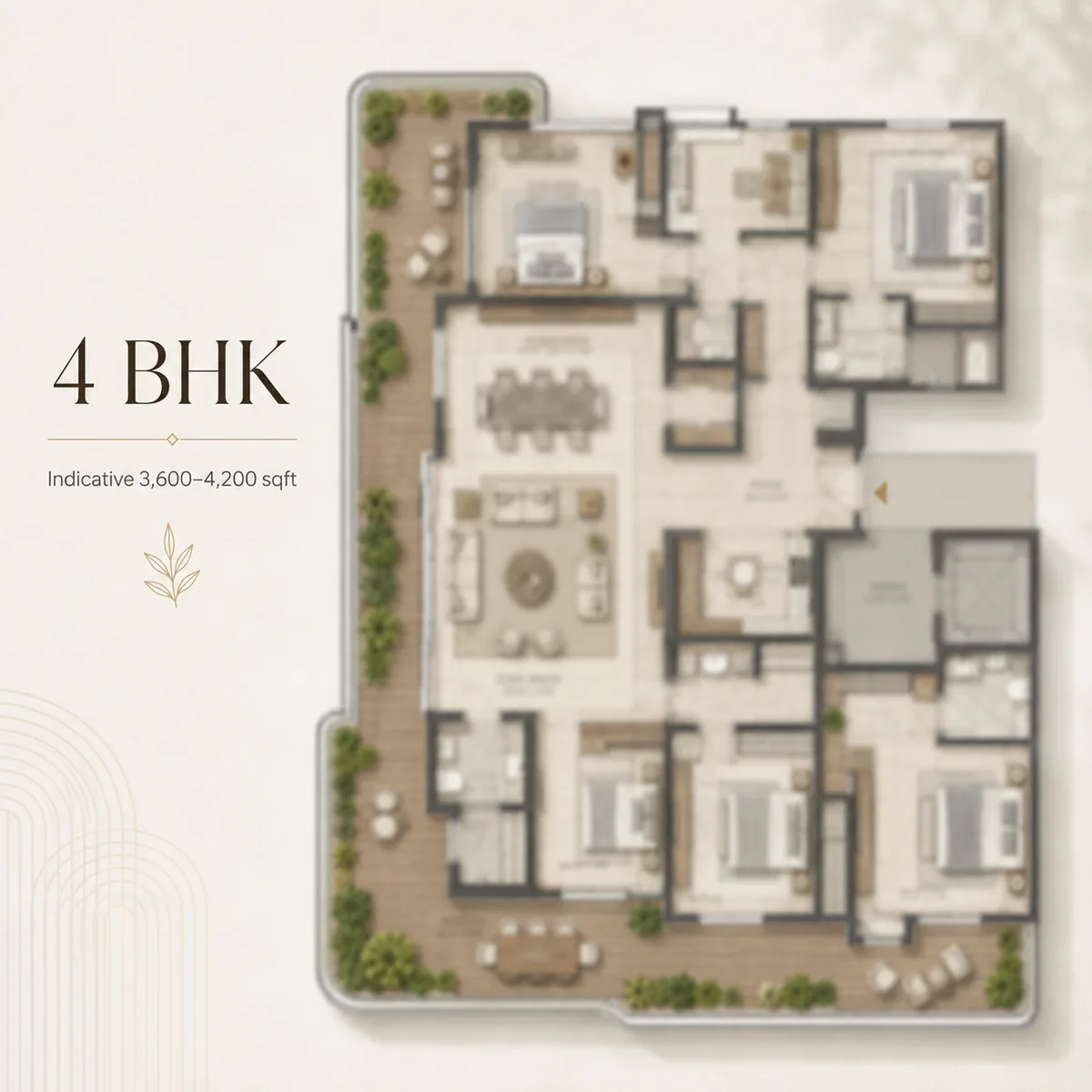
Total Environment has not released a floor plate for this project. What exists is a set of indications - 3 BHK homes of roughly 2,400 to 3,500 sqft and 4 BHK homes of roughly 3,600 to 4,200 sqft - and this page is explicit about where each of those numbers comes from. None of them is a published developer figure, and none should be treated as one when comparing against projects that have released drawings. In the same Bengaluru shortlist, Total Environment Yelahanka helps readers think beyond unit size and ask whether the format actually supports the routine they are buying for.
3 & 4
BHK planned
1,188
Total apartments
6
Residential towers
Not released
Floor plate
Configurations
What is indicated, and on what basis
| Configuration | Indicated size | Basis |
|---|---|---|
| 3 BHK Apartment | About 2,400 - 3,500 sqft | Client-supplied prediction. Not from any statutory document. |
| 4 BHK Apartment | About 3,600 - 4,200 sqft | Modelled from the filed built-up envelope at a 25-35 percent mix share. |
Both rows are estimates. The developer has published neither a floor plate nor a configuration mix, and these figures will move once it does.
A separate 4,500 to 6,000 sqft band for the 4 BHK appears in some circulated material. It has no independent support, no local precedent on this corridor, and it breaks the filed built-up area by 15 to 20 percent once the commercial tower is counted in. It survives here only as a possible low-volume upper-stack tier, not as a mainstream configuration. Third-party listings quoting 2,430 to 3,240 sqft are unverified marketing rather than a developer release, though they sit inside the plausible range.
The Arithmetic
Why these ranges are plausible
The filed programme gives 680,220.99 sq m of built-up area across six residential towers and one commercial tower, with 1,188 apartments. Strip out the commercial block and the basements, apply the usual loading between carpet, built-up and super built-up, and the residential average lands in the region these ranges describe. That is the whole of the envelope test - it constrains the answer without producing it.
What the envelope cannot tell you is the mix. A 1,188-home development weighted towards 3 BHK reads very differently from one weighted towards 4 BHK, in price, in resale depth and in who the neighbours are. Until the developer publishes the split, any per-unit ticket calculated from a per-sqft rate is compounding two estimates. Treat the sizes as a range to sanity-check against, not as a specification to buy on.
What To Ask
The questions worth asking when plans arrive
When the floor plate is released, the useful questions are structural rather than decorative. Ask for the carpet area alongside the super built-up figure, since the ratio between them is where two apartments of identical headline size stop being comparable. Ask how many apartments share each lobby and each lift core, because on a 36-storey tower that number sets the morning wait more than any amenity does.
Ask where the 4 BHK stock sits in the stack, since an upper-tier configuration concentrated in the top floors prices and resells differently from one distributed through the tower. And ask about the orientation of the units relative to the commercial tower - on a parcel where a 147 m block shares the address, sightlines and evening shadow are a real planning variable, not a detail.
Tower Stack
How the 1,188 homes are distributed
| Tower | Stack | Height | Apartments |
|---|---|---|---|
| Tower 1 | 3B+G+36 | 112.80 m | 296 |
| Tower 2 | 3B+G+36 | 112.80 m | 296 |
| Tower 3 | 3B+G+36 | 112.80 m | 148 |
| Tower 4 | 3B+G+36 | 112.80 m | 148 |
| Tower 5 | 3B+G+36 | 112.80 m | 148 |
| Tower 6 | 3B+G+37 | 115.80 m | 152 |
| Commercial | 4B+G+34 | 147.00 m | Not residential |
The residential counts sum to 1,188 exactly. Heights reconcile at a 3.05 m and 3.00 m residential floor module and a 4.20 m commercial module.
Availability
When plans become real
Floor plates normally become public at plan sanction, because that is the version that binds. No sanctioned plan or commencement certificate for this project is public, and Karnataka RERA registration has not been granted - and it is the RERA filing that puts the approved plans and the carpet-area schedule on a public portal where they can be checked rather than requested.
Until then, anything circulating as a floor plan for this project is either a marketing approximation or a drawing from a different project. That is worth saying bluntly, because plotted-layout material from an unrelated Total Environment scheme at Devanahalli has already been attached to this address once. If a plan is offered, ask which sanction it corresponds to and check that answer against the portal.
Buyer Questions
Total Environment Sarjapur Floor Plans - FAQ
What configurations are planned?
3 BHK and 4 BHK apartments. Indicated sizes are roughly 2,400 to 3,500 sqft for the 3 BHK and 3,600 to 4,200 sqft for the 4 BHK. Both are estimates - the developer has not released a floor plate.
Are these sizes confirmed by the developer?
No. The 3 BHK range is a client-supplied prediction not drawn from any statutory document, and the 4 BHK range is modelled from the filed built-up envelope. Neither has been published by Total Environment.
I have seen 4,500 to 6,000 sqft quoted. Is that right?
That band has no independent support and no precedent on this corridor, and it breaks the filed built-up area by 15 to 20 percent once the commercial tower is included. It is possible only as a small upper-stack tier, not as a mainstream configuration.
How many apartments are in each tower?
296, 296, 148, 148, 148 and 152 across the six residential towers, summing to 1,188. Five towers are 3B+G+36 at 112.80 m; the sixth is 3B+G+37 at 115.80 m.
When will actual floor plans be published?
Normally at plan sanction, and reliably at Karnataka RERA registration, which puts approved plans and the carpet-area schedule on a public portal. Neither has happened for this project yet.
Is this a plotted development where I build my own house?
No. It is an apartment development of 1,188 homes in six towers. Plotted-layout material describing plots of 1,800 to 5,000 sqft belongs to Tangled Up in Green at Devanahalli, a different Total Environment project about 40 km north of this site.